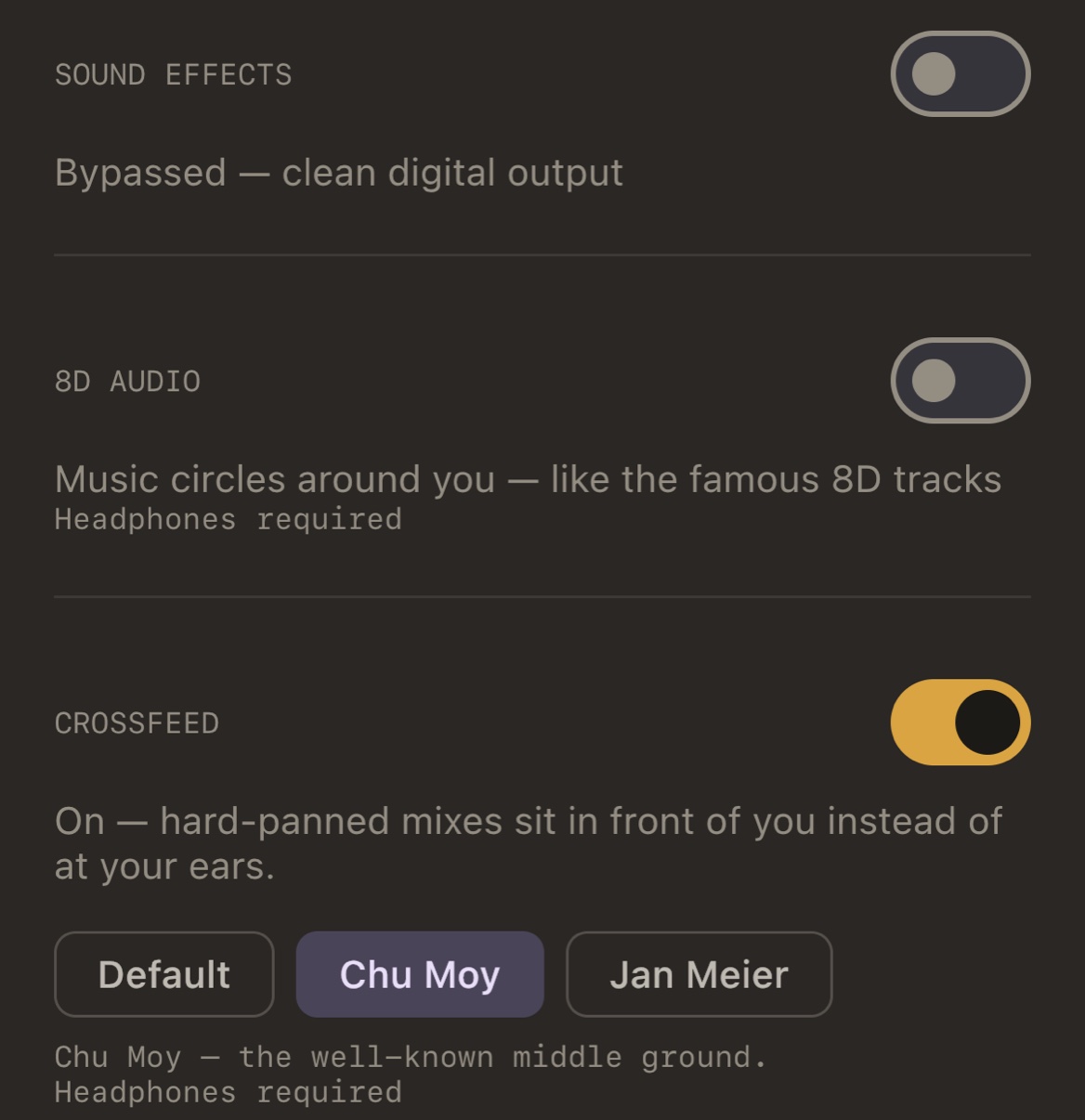
What it does
With speakers, each ear hears both speakers: the far one a fraction of a millisecond later and with less treble, because your head is in the way. Headphones remove that. Crossfeed restores a little of it: a low-passed copy of each channel goes to the other ear, delayed by the filter itself, while the near channel gets a matching shelf so the total stays level. Old stereo recordings with drums on one side stop being tiring; modern mixes gain a front.
Three presets from bs2b
| Preset | Cut-off | Level | Feel |
|---|---|---|---|
| Default | 700 Hz | 4.5 dB | The strongest; closest to speakers at ±30° |
| Chu Moy | 700 Hz | 6 dB | The well-known middle ground |
| Jan Meier | 650 Hz | 9.5 dB | The gentlest |
In bs2b the dB figure is how much quieter the far ear is than the near one, so a bigger number means weaker crossfeed.
Flat in the centre
Earlier crossfeed designs added a separate delay on top of the filter, and the two delays cancelled each other around 1 kHz, hollowing out the centre. MP95’s implementation follows bs2b: the filter’s own group delay is the interaural delay, and the centre stays within a gentle 1.8 dB tilt with no dip. The test suite measures eight frequencies for all three presets and checks that crossfeed switched off leaves the signal bit for bit untouched.
Where it sits
After the machine’s colour and before 8D. With 8D on, crossfeed is hardly audible, which is expected: 8D is already positioning the sound. Crossfeed is free on every platform, off by default, and does not need a limiter. It is in Settings → Sound on the phone and in the Settings panel on the Mac.
Frequently asked questions
Which crossfeed preset should I use?
Start with Chu Moy. If old stereo recordings still feel split, try Default; if you want only a hint, Jan Meier.
Is crossfeed the same as 8D?
No. Crossfeed makes headphones behave a little more like speakers. 8D moves the sound around your head as an effect.
Does it work on speakers?
It is meant for headphones; speakers already mix the channels in the room.